

Introduction: It’s Not About the Biggest Battery—It’s About the Right Battery
You’re investing in a solar battery for one of three reasons: to keep the lights on during a blackout, to slash your electricity bill, or to cut the cord with the utility grid for good.
But here’s the secret most installers won’t lead with: your goal, not your square footage, dictates the ideal battery size.
This guide cuts through the technical jargon. We’ll give you a simple formula, relatable examples, and the key specs to compare, so you can buy a system that fits your life—not one that’s oversized and overpriced.
Your Quick-Cheatsheet: How Much Capacity Do You Really Need?
For Backup Power (Storm Outages): 5 - 15 kWh
What it powers: Fridge, lights, wifi, phone charging for several hours to a day.
For Maximizing Savings (Peak Shaving): 20 - 30 kWh
What it does: Powers your evening energy use to avoid high time-of-use rates.
For Energy Independence (Off-Grid): 30+ kWh
The reality: Requires a large bank to get through multiple cloudy days, paired with a big solar array.
Pro Tip: The number on the box is a lie. A battery's usable capacity is less than its nameplate rating. Always factor in Depth of Discharge (DoD). A "10 kWh" battery with a 90% DoD only gives you 9 kWh of actual power.
Step 1: Define Your Power Goal (Your "Why")
Your motivation is your compass. Choose your path below:
Goal 1: Storm Mode & Backup Power
You want peace of mind during grid failures.
Your Focus: Essential appliances only.
Realistic Sizing: A single Powerwall-class battery (13.5 kWh) or a mid-sized 5-10 kWh unit can cover critical loads for hours. Start by listing your must-have devices (fridge, modem, sump pump)—we'll calculate their needs next.
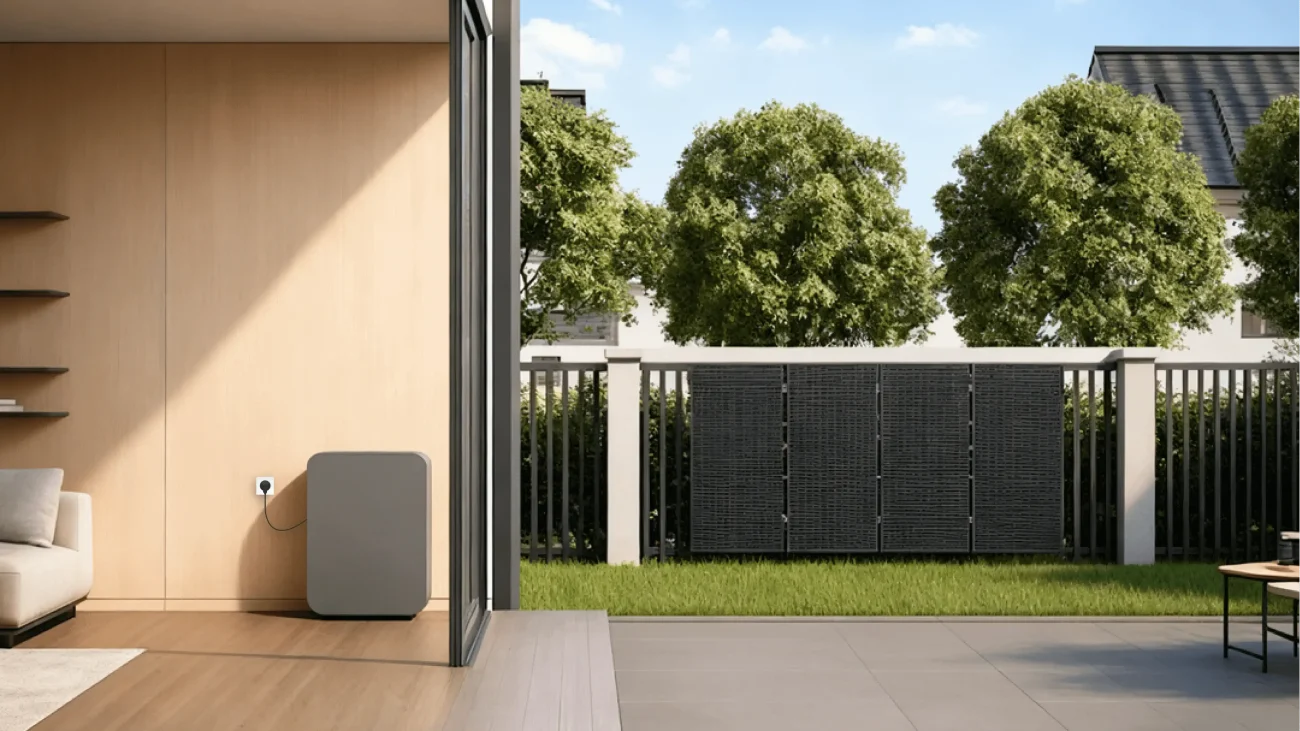
👉 Plug-and-Play Solution Spotlight: For those with minimal backup needs seeking ultimate simplicity, standalone solutions like the Batterlution PowerGo AC-Coupled All-in-One are ideal. These independent 2.5kWh or 5kWh units come with a standard Schuko plug, offering genuine plug-and-play operation by connecting directly to a European AC wall outlet for charging and discharging. This eliminates complex installation, making it a perfect "first step" into energy storage.

Goal 2: Slash Your Electricity Bill
You want to use your cheap solar power when it’s expensive to buy from the grid.
Your Focus: Your home’s typical evening energy use.
Realistic Sizing: This usually requires 2-3 average batteries (20-30 kWh total). The sweet spot depends heavily on your utility's rate plan. If you're on a time-of-use plan, a battery is your best weapon against peak pricing.
👉 Seamless Integration Spotlight: The key here is adding storage without complex, costly re-wiring. The Batterlution PowerGo, as an AC-coupled system, is designed for this. It installs alongside your existing home energy system, seamlessly integrating with most solar setups to store excess solar energy for use later in the day.
Goal 3: Total Energy Independence
You aim to disconnect from the utility grid completely.
Your Focus: Worst-case weather scenarios.
Realistic Sizing: Think in terms of a small power plant. Systems start at 30 kWh and can easily exceed 50 kWh. This is a major financial and engineering project that requires a custom design.
👉 Critical Feature Check: For true off-grid capability, you must ensure the battery system is specifically designed for it. When considering a system, verify it has a dedicated off-grid mode, like the off-grid version of the PowerGo. These systems are engineered to create a stable, independent microgrid, which is a fundamentally different requirement than just backing up a grid-tied home.
Step 2: The Simple Sizing Formula
You don't need an engineering degree. Just this formula and 10 minutes.
The Core Formula:
Required Usable Capacity (kWh) = Total Appliance Power (kW) × Backup Time (Hours)
Let’s walk through a backup power example:
List Your Essentials & Their Power:
Refrigerator: 150W
LED Lights: 150W
WiFi & Phones: 50W
Sump Pump: 800W (runs intermittently)
Total Continuous Load: 0.35 kW
Estimate Your Desired Backup Time:
Let’s plan for a 12-hour outage.
Calculate Your Basic Need:
0.35 kW × 12 hours = 4.2 kWh
Account for the Sump Pump:
(If it runs 15 min/hour): 0.8 kW × 3 hours = 2.4 kWh
Total Usable Capacity Needed: 4.2 kWh + 2.4 kWh = 6.6 kWh
The Most Important Step: Adjust for Real-World Losses
No battery is 100% efficient. You must divide your need by the battery's Depth of Discharge (DoD) and Round-Trip Efficiency.Final Nameplate Capacity = Usable Capacity Needed ÷ (DoD × Efficiency)
*For our 6.6 kWh need, with a high-quality LFP battery (95% DoD, 95% efficiency):*
6.6 kWh / (0.95 × 0.95) = 7.3 kWhConclusion: A battery with a nameplate capacity of approximately 8 kWh is your perfect fit.
Real-World Fit: This calculated need of ~8kWh shows how a combination of independent units can provide a tailored solution. For instance, one 5kWh standalone PowerGo unit could cover the core load, with the option to add a second independent unit later if your needs grow, demonstrating a flexible approach without requiring a stackable system.
Other Solar Battery Factors to Consider: Cost, Warranty, and Reputation
Once you know your size, use these three specs to find a quality product.
Specification | What It Means | Why It Matters | What to Look For |
|---|---|---|---|
Depth of Discharge (DoD) | The % of the battery you can actually use. | A higher DoD = more value from your purchase. | LFP Batteries: 90-100% DoD. The gold standard. |
Ease of Installation | How complex and costly it is to get the system operational. | Impacts upfront cost and flexibility. | Look for plug-and-play solutions that require no specialized wiring, like systems with standard Schuko plugs, for the simplest setup. |
Warranty | The manufacturer's guarantee on defects and capacity retention. | This is the best indicator of long-term value. | Look for a long warranty (10+ years) that guarantees a high end-of-warranty capacity (e.g., 70% after 10 years). |
Your Action Plan: 3 Steps to Confidence
Audit Your Home: Use your utility's energy usage tool or a simple plug-in energy monitor to understand your "always-on" and evening loads.
Run the Formula: Use the calculation above to get a ballpark kWh figure for your goal.
Get Quotes & Ask the Right Questions: When talking to installers, ask:
"What is the usable capacity of this system, factoring in the Depth of Discharge (DoD)?"
"Can you show me the warranty details for capacity retention?"
"For my needs, is a simple, standalone AC-coupled unit a suitable and cost-effective option?"
Conclusion
Choosing a solar battery is a significant decision. By starting with your goal, using a simple formula to ground your expectations, and knowing which specs truly matter, you transform from a confused consumer into an empowered buyer.
You are now equipped to have an informed conversation with any installer and select a system—whether a large fixed unit or a flexible, standalone plug-and-play solution like the Batterlution PowerGo Series—that delivers the power, savings, and peace of mind you deserve.