

What is a hybrid solar inverter, thermal storage tank, and wind turbine
Introduction:
As the lever of the world’s energy paradigm shift pivots towards sustainable solutions, a thorough understanding of Hybrid Solar Power Inverters, Thermal Storage Tanks, wind turbines and the comparison between the number of Solar Panels equivalent to a Wind Turbine becomes crucial. This article unravels these exciting know-hows, shedding light on their functions, benefits, and the equation comparing solar and wind energy production.
What is a Hybrid Solar Inverter?
Hybrid inverter solar is an intelligent device to manage the solar generation, battery storage, load management and feed-in the grid. Making the switch to renewable energy involves various components, and at the top of the list is the Hybrid Solar Inverter. This advanced piece of technology seamlessly blends the functionalities of regular solar inverters with the capabilities of managing an energy storage solution. Unlike traditional inverters, Hybrid Solar power Inverters facilitate the storage of excess solar energy for later use, ensuring a consistent power supply and augmenting self-sustainability. these inverters have redefined modern solar installations, marking a significant milestone in the solar energy sphere.
hybrid grid tie inverter must be connected to the utility grid. Different countries have different grid regulation for voltage, feed-in active power, reactive power and frequency. So the hybrid inverter must be certificated by the grid standards such as VDE4105 for German, G98, G99 for UK and EN50438 for Europe.
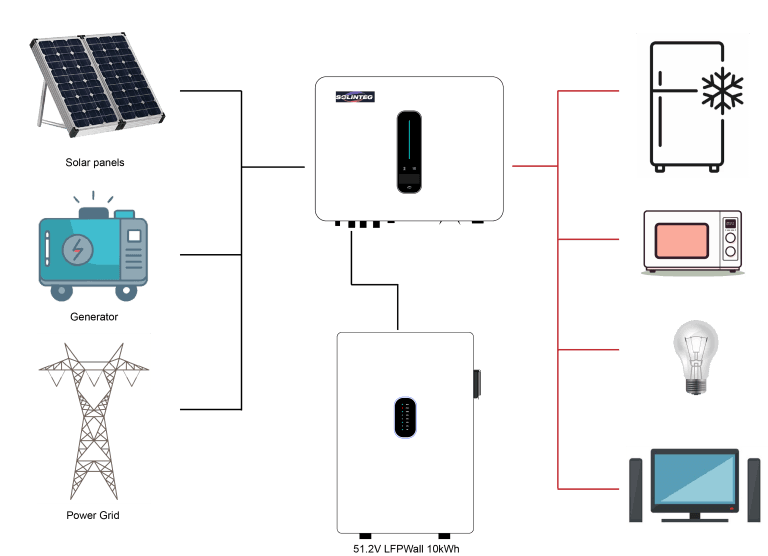
Decoding a Hybrid Solar Power Inverter:
Functioning beyond the traditional role of converting direct current (DC) to alternating current (AC), Hybrid Solar Power Inverters, often associated with an evolved inverter technology, serve as intelligent managers that govern the flow of electricity between the solar panels, batteries, and the grid. By optimizing power production, storage, and consumption, they create a harmonized power ecosystem that enhances overall energy efficiency.
What is a thermal storage tank
A thermal energy storage system is a device used to store and manage renewable thermal energy until it is needed. It finds wide application in many industrial sectors.
The working principle of a thermal energy storage system is to heat water using the heat from steam and store this thermal energy. When high-temperature steam passes through the storage system, it transfers heat to the water via a heat exchanger. This heats the water to a high temperature, converting the heat of the steam into thermal energy stored in the water. This hot water can then be used as a thermal energy storage medium for later use. When thermal energy is needed, the hot water can be transported through the system's piping to where it is required for heating, washing, power generation, or other processes.
What is the role of a thermal storage tank in renewable energy systems?
Solar energy systems are incomplete without Thermal Storage Tanks. Especially crucial for Concentrated Solar Power (CSP) technology, these tanks capture and store the excess heat generated by solar collectors during peak sunlight hours. The stored energy can later provide a continuous and reliable power supply during periods of lower sun exposure, effectively turning solar power into a round-the-clock energy solution. This functionality adds a layer of flexibility and dependability to the clean energy sector.
Now people also use the phase-change material as the thermal storage medium.
What is a wind turbine
Wind energy is a renewable energy source. Wind turbines are the primary devices used in wind power generation. A wind turbine is a large structure composed of several rotating blades attached to an electromagnetic generator. As wind interacts with the blades, it creates lift, causing the blades to rotate. This rotational motion is then transmitted to the generator via a drive shaft, converting the kinetic energy of the wind into electrical energy. Wind farms consist of multiple wind turbines connected together to produce electricity on a large scale. These farms can be located onshore or offshore.
How Wind Turbines Work
Wind turbines harness the power of the wind to generate electricity. When the wind blows, it turns the large blades of the turbine. These blades are connected to a rotor, which spins a generator. The generator converts the mechanical energy of the spinning rotor into electrical energy.
To optimize energy production, wind turbines are often grouped together in wind farms. These farms are located in areas with consistent, strong winds. A control system regulates the speed of the turbine blades and the generator. Safety features, such as brakes, ensure that the turbine can be stopped quickly if necessary.
Wind turbines also have components that allow them to adjust their orientation to face the wind. This helps to maximize the amount of energy captured.
How many solar panels equate to one wind turbine
A common question when exploring renewable energy options is how many solar panels would be equivalent to a single wind turbine. The answer is multifaceted and depends on several factors.
Firstly, the rated capacity of both the wind turbine and the solar panels plays a significant role. A wind turbine's rated wind speed is a specific value. The power output of a wind turbine is directly related to wind speed. While there's a minimum wind speed for a turbine to start rotating, most turbines are designed to safely brake at higher wind speeds. Unlike solar power, wind turbines can generate electricity even at night if there's wind, providing a consistent power source.
A typical 1.5MW wind turbine has a rated capacity at around 25mph wind speeds. Assuming a 400W solar panel produces approximately 300W under standard test conditions (STC), which is at a cell temperature of 25°C, a solar irradiance of 1000W/m², and an air mass of 1.5, it would take roughly 5000 of these 400W panels to match the output of the 1.5MW wind turbine under those specific conditions. This is a snapshot comparison, however, and doesn't account for real-world variations or losses.
The annual energy production of a wind turbine or solar panel can vary significantly depending on the specific location. For instance, a wind turbine in a windy region will produce more electricity than one in a calm area. Similarly, a solar panel in a sunny location will generate more energy than one in a cloudy region.
A summary of hybrid solar inverters, thermal storage tanks, and wind turbines
The era of clean and green renewable energy heralds a future where Hybrid Solar Power Inverters and Thermal Storage Tanks are invaluable components. By providing an in-depth understanding of these technologies, along with the solar to wind energy equivalence, this article aims to inspire technological advancements in the landscape of sustainable energy solutions. As we continue to explore these innovations, we get one step closer to a future of resilience, environmental responsibility, and enhanced energy efficiency. How to manage distributed energy resources?