

Photovoltaic Power Calculation: The Essential Guide with Formulas and Examples
Accurate solar power generation calculation is the foundation of any successful PV project planning. Whether for a residential rooftop or a utility-scale plant, understanding how to calculate solar power generation directly impacts financial forecasting and return on investment. This guide provides the essential photovoltaic calculation formulas, from quick estimates to detailed engineering methods, enabling you to perform reliable power generation calculations.
Quick Start: Choose Your Calculation Method
Yout Goal | Recommended Method | Core Formula | Best Use Case |
|---|---|---|---|
Initial Feasibility & Quick Quote | Peak Sun Hours Method | E = P x h | Preliminary assessment, rapid ROI estimation |
System Design & Accurate Yield Forecast | Complete System Formual | E = P x G x PR | Project planning, performance guarantees |
Technical & Engineering Analysis | Instantaneous Power Formula | P(t) =f(G, T) | System optimization, performance modeling |
Step 1: Core Component Efficiency Parameters
1. Photovoltaic Module Efficiency
The photoelectric conversion efficiency of your chosen module is the starting point for any solar power equation. Always refer to the manufacturer's datasheet for exact values.
Different materials for photovoltaic modules have varying photoelectric conversion efficiencies:
Project | Monocrystalline Sillcon Module | Polycrystalline Silicon Module | Amorphous Silicon Thin Film Module | Concentrated PV Module |
|---|---|---|---|---|
Manufacturing Level | Mature process, diverse models,supports large-scale production | Not commercialized,not yet capable of large-scale production | ||
Technology Maturity | Mature | Immature | ||
PV Conversion Rate | 18%~20% | 16%~18% | 5%~9% | 25%~30% |
Applicable Locations | Suitable for areas with high direct readiation;performance decreases at high temperatures | Suitable for areas with high direct readiation | Suitable for areas with high direct readiation,less affected by temperature,requires 40% more area than the first two types | Requires a sun-tracking system and a large installation area |
2. System Losses: Inverter and Performance Ratio
Inverter conversion efficiency is a major loss factor. Currently, high-quality string inverters typically have a "European weighted efficiency" between 96% and 98%, with maximum efficiency exceeding 99%. These losses, combined with wiring, soiling, shading, and thermal losses, define the system's overall Performance Ratio (PR).
Step 2: The Core Photovoltaic Power Calculation Formula
All detailed solar power plant calculations are derived from this fundamental photovoltaic formula:
Ep = PAZ × Gmod × PR
Ep: Annual energy production (kWh) – the final result of your solar yield calculation.
PAZ: Installed peak power (kWp).
Gmod: Total in-plane solar irradiation (kWh/m²) – the most critical variable.
PR: Performance Ratio – a comprehensive efficiency factor (typically between 0.75 and 0.85 for well-designed systems).
Efficiency | |||||||
|---|---|---|---|---|---|---|---|
Max.efficiency | 97.4% | 97.4% | 97.4% | 97.4% | 97.6% | 97.6% | 97.6% |
European efficiency | 96.5% | 96.5% | 97.0% | 97.0% | 97.0% | 97.1% | 97.1% |
MPPT efficiency | 99.9% | ||||||
Step 3: Calculating Annual power generation for the PV solar station
Accurately performing power generation calculations for a photovoltaic system is the key to predicting its performance and return on investment. This section will guide you through the core photovoltaic calculation formula and inputs needed for a reliable solar power generation calculation.
3.1 Total Solar Radiation on a Horizontal Surface (The Foundational Data)
The starting point for any solar power generation calculation is understanding the local solar resource. Horizontal solar radiation (Shorz) refers to the total energy from solar radiation on a horizontal surface at a specific geographic location. This includes both direct radiation from the sun and diffuse radiation scattered in the atmosphere.
When predicting the output of a home photovoltaic power station, the first step is to find the annual solar radiation on a horizontal surface for your location. This value varies by season and location, and is the critical first input into any photovoltaic formula or solar power equation.
For Germany, here are typical annual average horizontal solar radiation values:
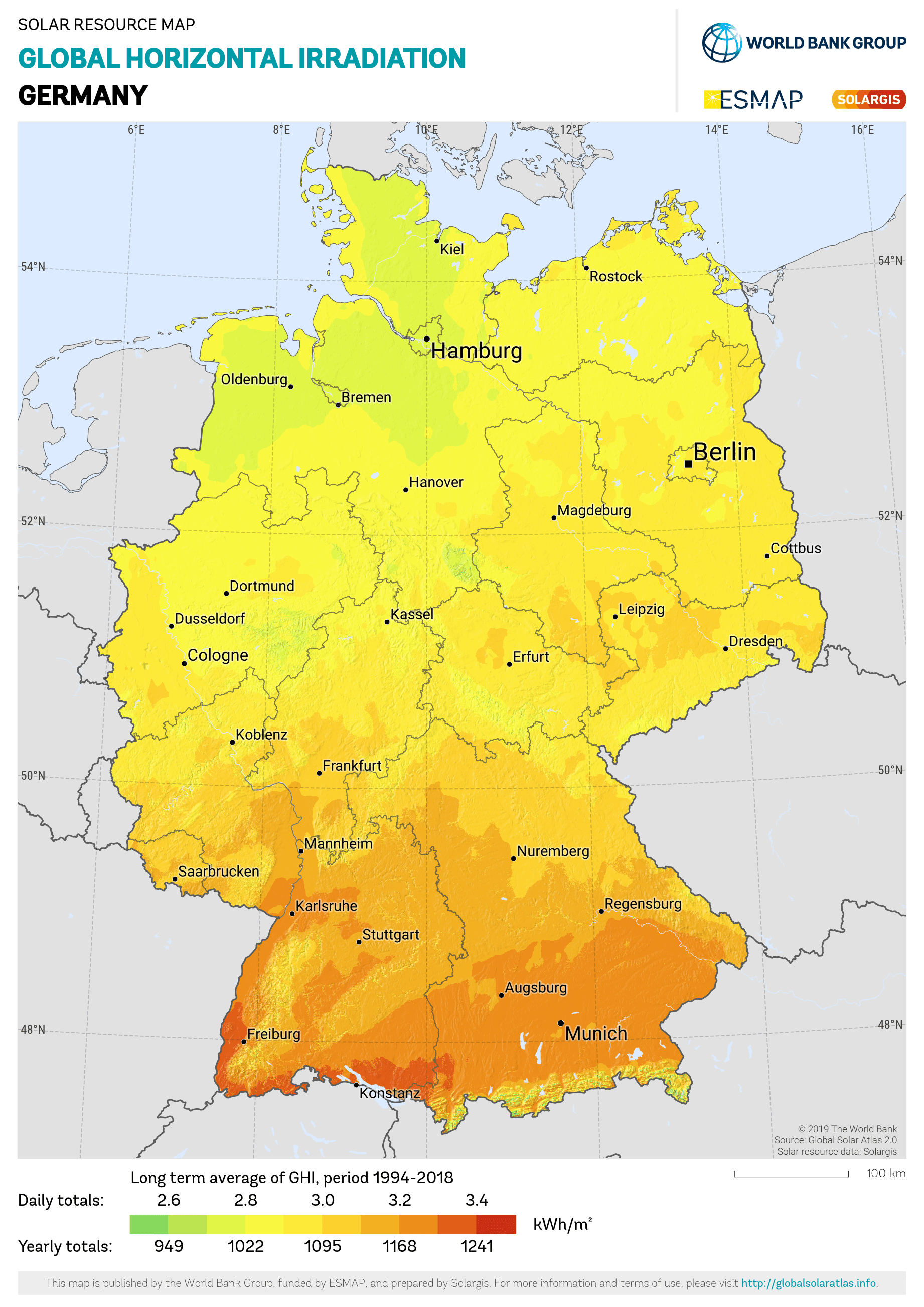
You can choose the required solar radiation value based on your address to use in the following photovoltaic power generation forecast calculation.
3.2 Orientation of Photovoltaic Modules (Maximizing Exposure)
The orientation of PV panels significantly affects the system's efficiency. In the Northern Hemisphere, panels should ideally face south to capture the maximum annual solar radiation. While east-west orientations can provide more balanced daily production, the solar power equation for annual yield favors south-facing installations in most solar plant calculations.
Orientation Reference for Germany in the Northern Hemisphere:
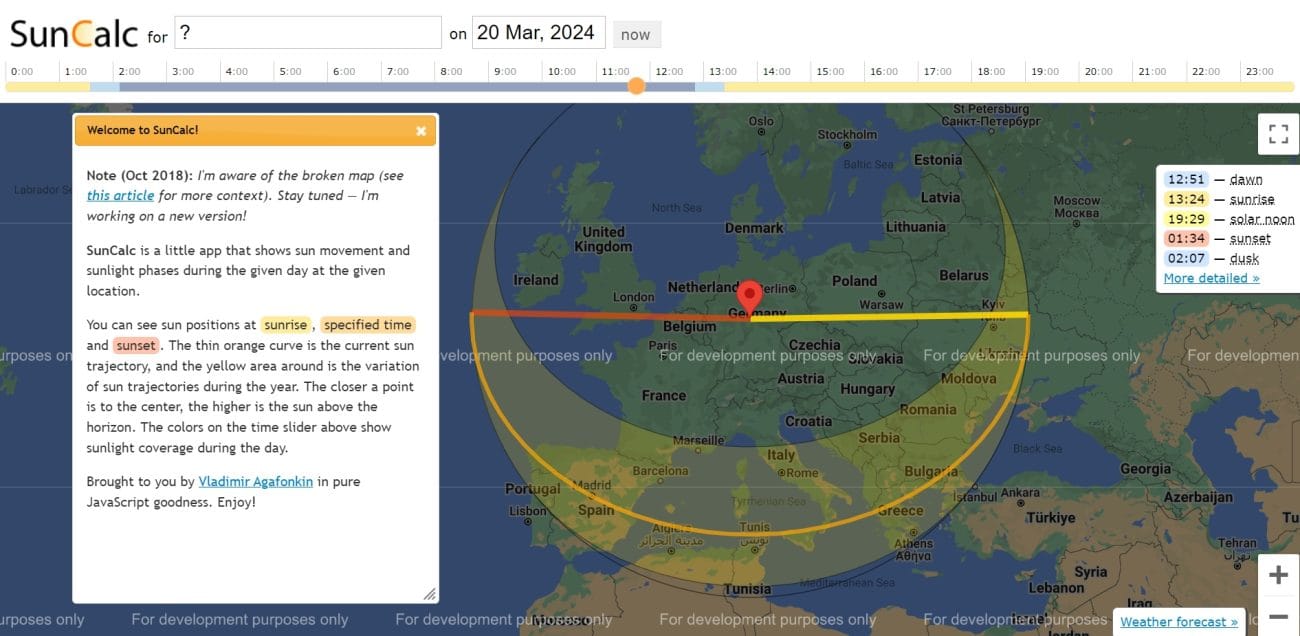
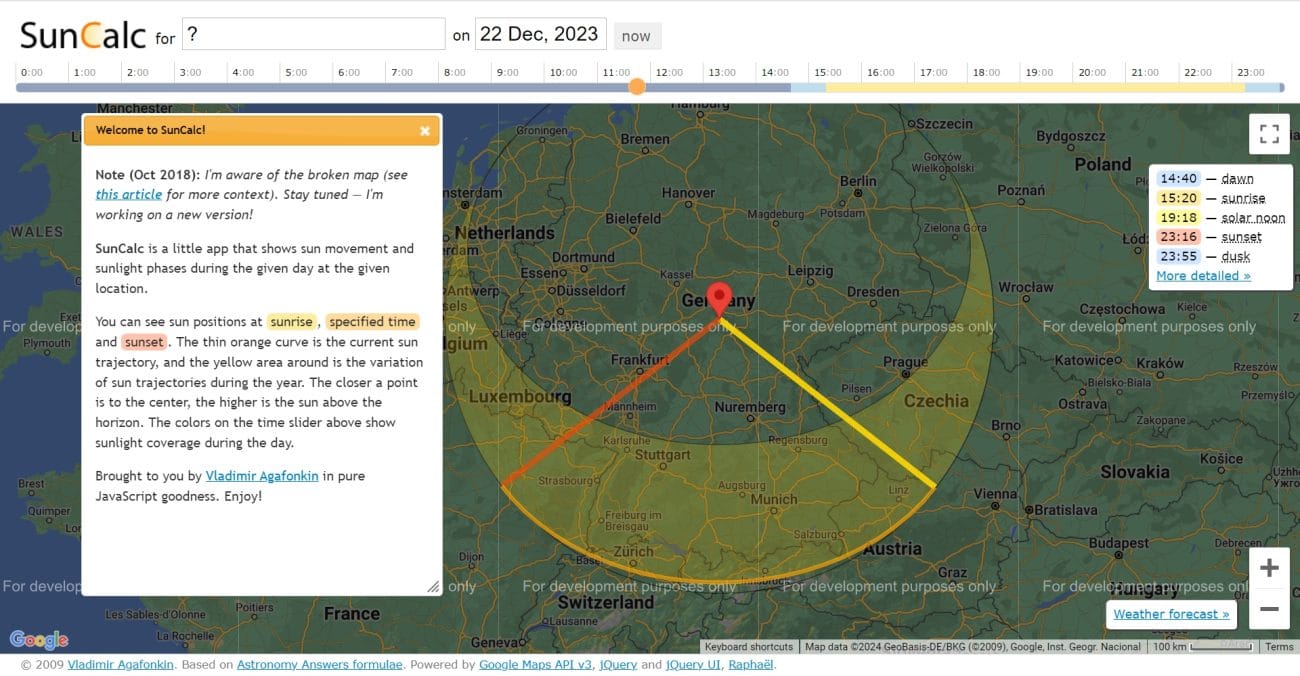
From the above two pictures, you can clearly see where the sun rises and sets in March and December. The best photovoltaic panel orientation in Germany is where the two pictures overlap.
3.3 Tilt Angle and the Core Photovoltaic Calculation Formulas
The tilt angle of photovoltaic panels is the angle between the panels and the horizontal ground. This angle is crucial for maximizing solar radiation reception and energy output of the entire photovoltaic system. Ideally, the tilt angle should equal the latitude of the installation location to receive the maximum direct solar radiation.
The tilt angle of photovoltaic panels refers to the angle between the panels and the horizontal ground. This angle significantly affects the reception of sunlight and the overall energy output of the photovoltaic system.
For residential photovoltaic systems, the installation position is fixed. To achieve higher electricity generation, it is advisable to adjust the tilt angle of the panels to the optimal angle as much as possible. This allows for maximum solar radiation absorption and consequently higher electricity production.
Optimal Tilt Angle Calculation:
The optimal tilt angle ensures maximum solar radiation reception. However, the sun’s position changes daily and seasonally. Typically, the optimal tilt angle is estimated using the latitude and longitude of the area.
the approximate ideal inclination for solar panel installation can be calculated using equation (1):
M=(ψ+ψ/3)+(L-L/3)÷2
Where:
M——annual angular average, in degrees;
ϕ——latitude, in degrees;
L——longitude, in degrees
Calculation of the Equivalent Solar Radiation for the Tilt Angle of Photovoltaic Panels:
Equivalent solar radiation value refers to the radiation value of the sun light on the photovoltaic panel, which can be calculated by a series of formula conversion and local level solar radiation value.
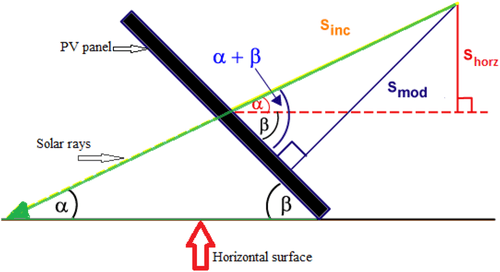
Formula for the equivalent solar radiation value:
Smod=Shorz x sin(α+β) ÷ sinα
α = 90 - ψ ± 23.5°
α is the angle of Solar Azimuth, Solar azimuth is an angle that describes the direction of the sun in the sky relative to the observer, which changes over the course of the day and throughout the year.
EP = PAZ x Smod ÷ ES
PAZ——Component installation capacity(kWp)
Ep——PV station power generation(kWh)
Es——Irradiance under standard conditions (constant =1kWh / m2)
For example, in Berlin, longitude and latitude is 52.5244°, longitude is 13.4105°, the installation of a 1600W PV solar power station, its power generation is expected to be:
β= M = (ψ+ψ/3)+(L-L/3)÷ 2 = (52.52 + 52.52/3)+ (13.41 - 13.41/3)÷2 ≈ 39°
α = 90 -ψ=90 - 52.52 ≈ 38°
Smod=Shorz x sin(α+β)÷sinα=1050 x sin(39+61)÷ sin61 ≈ 1088kWh/m2
EP = PAZ x Smod = 1088 x 1600 = 1740.8kWh
Electricity generation calculation considers the equivalent solar radiation based on tilt angle and orientation. Estimating electricity generation involves incorporating the above values, but different orientations will still yield varying results.
Step 4: Simple Formula for Estimating Power Generation (The Peak Sun Hours Method)
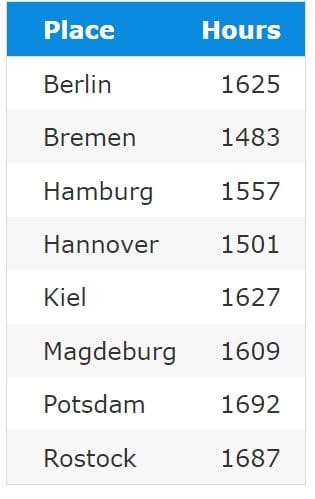
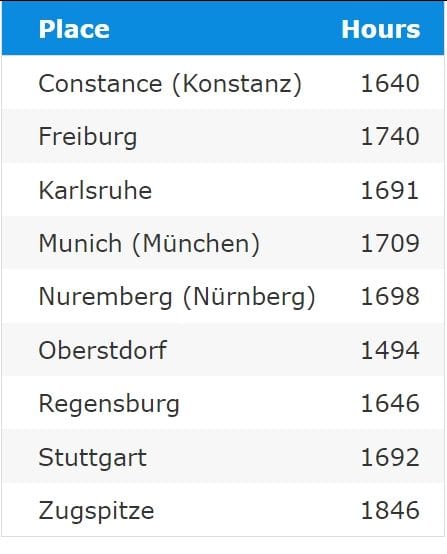
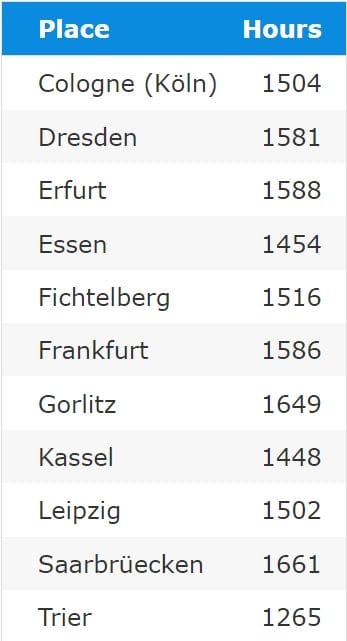
To estimate the power generation of a photovoltaic power station simply, you can use the annual solar utilization peak hours to calculate the station's power output.
Annual peak solar utilization hours is a measure of the average number of hours of solar energy available in a region during a year. That is, the peak solar time. It is often used to assess an important indicator of the power generation potential of solar photovoltaic systems. In simple terms, the annual peak solar utilization hours represent the total amount of solar energy available in a region in a year if the solar intensity is constant at the ideal state (that is, a power of 1 gigawatt per square meter).
Power generation calculated by peak solar time:
EP = PAZ x h
h——the region’s average annual peak sunshine hours, found in tables listing the average annual sunshine hours for various regions.
PAZ——Component installation capacity(kWp)
Ep——PV station power generation(kWh)
Step 5: Simulation Calculation Websites
For the most accurate solar yield calculation and detailed financial analysis, online simulation tools are recommended. These platforms automate all the complex power generation calculations and photovoltaic formulas discussed above. Simply input your location, system size (e.g., a compliant 800W balcony system), tilt, and orientation to get a precise forecast.
By mastering these methods—from the simple solar power equation to the detailed photovoltaic calculation formula—you can confidently estimate the power generation of any PV system, from a residential rooftop to a balcony power station that perfectly complies with the new 800W regulations.