
Do you know about N-type solar panels and p-type solar panels
N-type and P-type solar cells are two prevalent types of semiconductor materials employed in the fabrication of solar panels. The designations "N" and "P" refer to the primary charge carriers within each material: N-type for negative charges (electrons) and P-type for positive charges (holes).
N-type solar panels are the next generation of solar cell technology. Unlike more common P-type solar panels, N-type panels use N-type silicon as the substrate. This material is more pure and less likely to contain impurities, which improves electron flow. P-type solar cells are made from P-type silicon wafers, which are created by doping silicon crystals with elements such as boron. This doping creates holes in the silicon crystal, which are positively charged. In simple terms, N-type panels are more efficient at converting sunlight into electricity.
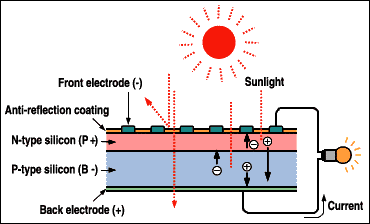
The working principle of N-type solar cells is the same as that of P-type solar cells. When sunlight hits the panel, photons are absorbed and excite electron-hole pairs. The electrons and holes move along the N-type and P-type semiconductors, respectively, creating a voltage potential. This voltage potential can be used to drive current.
How are N-type and P-type solar panels manufactured?
The manufacturing process of N-type solar panels is similar to that of P-type solar panels, but with some additional steps. First, a silicon crystal is pulled into a thin wafer, then polished and cleaned. Next, the wafer is doped with phosphorus to create the N-type layer. Then, boron is diffused into the wafer to create the P-type layer. Finally, the N-type and P-type layers are connected to form a PN junction.
The manufacturing process of P-type solar cells mainly uses traditional Al-BSF (aluminum back surface field) technology and PERC (passivated emitter rear contact) technology. Al-BSF technology is to deposit aluminum on the back of the cell to form a back field to improve the conversion efficiency of the cell.
The manufacturing process of N-type solar panels is more complex, so the cost is also higher. However, N-type solar panels have higher conversion efficiency and longer service life, so they are economically efficient in the long run.
Why are N-type solar panels more efficient than P-type solar panels?
The main difference between N-type and P-type solar panels is the doping material they use. Doping is the process of adding chemical elements to crystalline silicon (c-Si) to alter its electronic structure and improve the efficiency of the solar cell.
N type solar cells are doped with phosphorus, which has one more electron than silicon. This means that N-type solar cells have free electrons that can be excited by photons and generate current.
P type solar cells are doped with boron, which has one fewer electron than silicon. This means that P-type solar cells have holes that can be excited by photons and generate current.However, boron can undergo light-induced degradation (LID) when exposed to light and oxygen. LID can cause a decrease in the efficiency of the solar cell, so the efficiency of P-type solar cells will decrease over time.
N-type solar cells do not contain boron, so they are not susceptible to LID. This means that N-type solar cells are more efficient and have a longer lifespan.

N-type and P-type solar panels: Pros and cons
N-type and P-type solar cells are the two most common types of solar cells. They have their own advantages and disadvantages, making them suitable for different applications.
N-type solar cells
N-type solar cells have the following advantages:
They are not susceptible to light-induced degradation, which means they are more efficient and have a longer lifespan.Their conversion efficiency is higher than that of P-type solar cells, and has reached over 25%.
N-type solar cells also have some disadvantages:
They are more expensive, and currently have a smaller market share.


P-type solar cells:
P-type solar cells have the following advantages:
They are less expensive, and have a larger market share.They are highly resistant to radiation, making them suitable for high-radiation environments.
P-type solar cells also have some disadvantages:
They are susceptible to light-induced degradation (LID), which can lead to efficiency loss.They have a shorter lifespan than N-type solar cells.
Which solar panel is right for you?
When you're starting to choose components for a new solar system, you need to consider the following factors to determine which solar panel is right for you: budget, energy needs, and available installation space.
N-type solar panels have a higher upfront cost, but they are more efficient and can generate more energy. P-type solar panels have a lower upfront cost, but they are less efficient.
If you have a smaller available installation space but high energy needs, N-type solar panels may be a better choice. If you have a larger available installation space and a limited budget, P-type solar panels may be a better choice.
Conclusion
N-type and P-type solar cells have their own advantages and disadvantages. N-type solar cells are more efficient and have a longer lifespan, but they are more expensive. P-type solar cells are less expensive and are more resistant to radiation, but they are susceptible to light-induced degradation and have a shorter lifespan than N-type solar cells. When choosing a solar panel, you need to consider your specific needs and circumstances.