
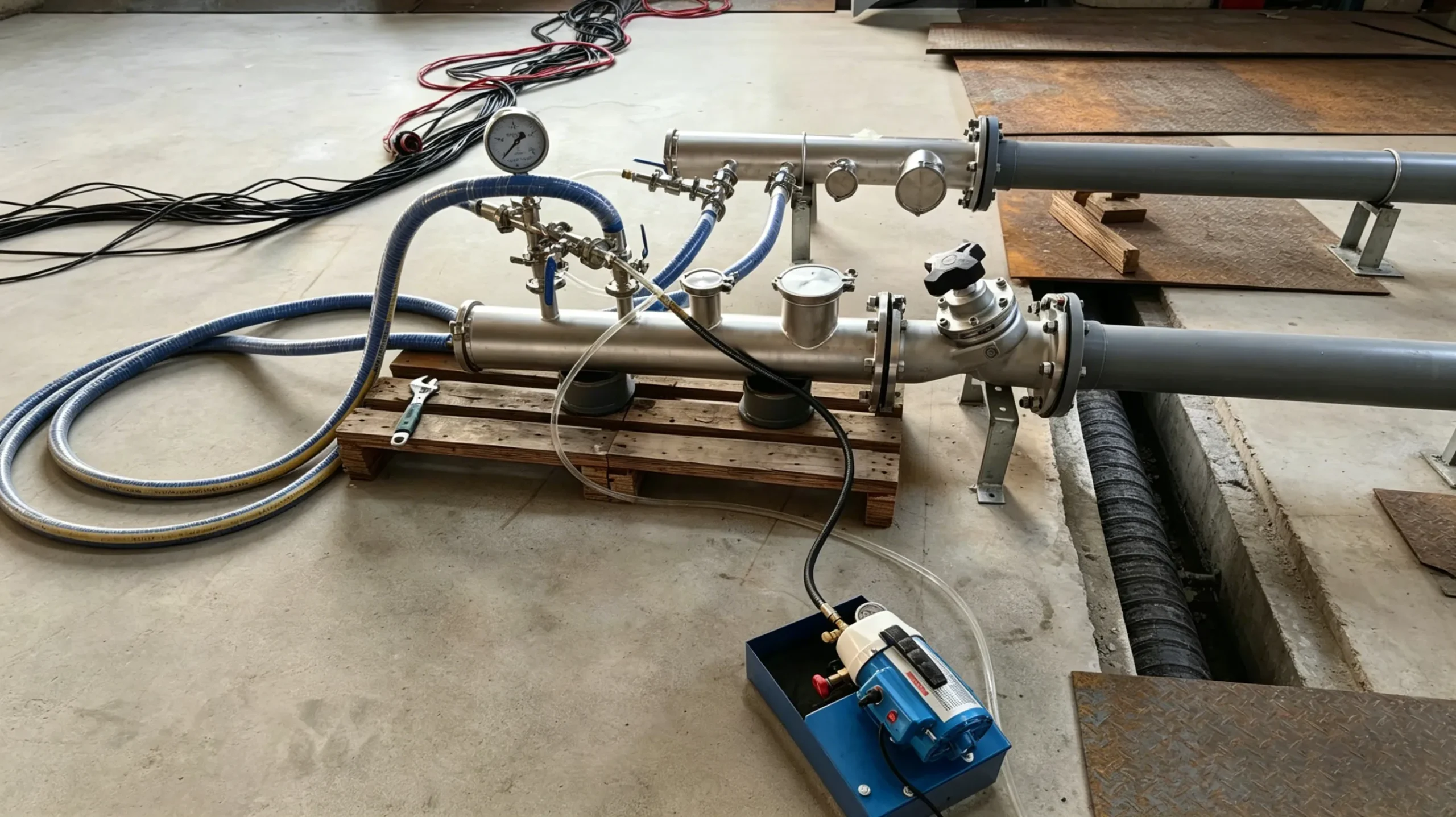
Liquid Cooled Load Bank Testing Guide
How to Choose a Manifold for Load Bank Testing
For liquid cooled data centers, CDU commissioning, and rack-level cooling loop validation, the manifold is not just a piping accessory. It affects UQD quick disconnect compatibility, blind-mate manifold interfaces, flow stability, pressure drop, Delta T across the CDU, heat rejection capacity, dew point control, and coolant cleanliness records.
Manifold Is Not an Accessory, but the Key Interface for Liquid Cooled Load Testing
In many CDU commissioning projects, the load bank is treated as the heat source and the manifold is treated as a simple connector. That view is too narrow for liquid cooling validation.
During a liquid cooled load bank test, the manifold defines how coolant enters the load bank, how it is distributed across branches, how it returns to the CDU, and whether the measured data reflects real rack operating conditions.
If the manifold is poorly selected, the load bank may still reach its rated kW, but the test result can be misleading. Common problems include unstable coolant flow rate, excessive local pressure drop, abnormal Delta T, trapped air, leakage at quick disconnects, and particulate contamination in the loop.
For this reason, the manifold should be specified together with the test objective, not added as a last-minute piping adapter. Batterlution can configure a liquid cooled load bank around the CDU interface, rack manifold structure, coolant type, and commissioning workflow.
Before Choosing a Manifold, First Confirm What the Test Object Is
If the test only needs to confirm the heat exchange performance of one liquid cooled load bank, the manifold can be relatively simple. The main checks are target flow rate, differential pressure, port size, venting, draining, and connector compatibility.
If the test must validate a full rack cooling loop, the manifold should simulate the real rack manifold structure and support rack manifold loop validation. This includes supply and return paths, branch balancing, differential pressure measurement, leak checks, air removal, and repeated connection cycles.
If the test is part of CDU commissioning or data center liquid cooling acceptance, the manifold may need to work with a commissioning manifold trolley. A trolley-style interface helps the site team move between racks, connect quickly, refill or purge the loop, and record commissioning data.
Engineering rule: the closer the test is to a real deployment, the less the manifold can be selected by pipe size alone. It must match the interface, flow rate, pressure drop, coolant, measurement points, and site operating procedure.
UQD Quick Disconnect Compatibility: Suitable for Frequent Connection and Rack-Level Testing
UQD quick disconnect fluid connector compatibility is not only about faster connection. It reduces the risk of leakage, wrong connection, unnecessary rework, and inconsistent test conditions when equipment is connected and disconnected many times.
For CDU FAT, liquid cooled server rack tests, staged data center commissioning, and projects that need frequent switching between test objects, UQD compatibility can directly affect test efficiency and repeatability.
Blind-Mate Interface: Closer to Real Rack Go-Live Conditions
If the project involves liquid cooled server racks, especially racks that are pushed into position and connected with limited access, the manifold should support a blind-mate manifold interface.
The key value is not appearance. It is alignment tolerance, sealing reliability, and stable performance across repeated mating cycles. A blind-mate test can reveal misalignment, insufficient seal compression, reversed supply and return paths, connector resistance changes, and maintenance-space limitations before the actual rack goes live.
Flanged and Grooved Connections: Suitable for High-Flow Main Loops
For main supply and return piping, CDU outlet connections, and trolley main ports, common options include flanged / Victaulic fittings.
Flanged connections are suitable for fixed, large-diameter, high-reliability installations. Victaulic grooved fittings are often better for temporary commissioning pipework, mobile test systems, and commissioning manifold trolleys because they are faster to install and remove on site.
Manifold Selection Recommendations for Different Test Scenarios
| Test scenario | Recommended manifold type | Key validation points | Related search terms |
|---|---|---|---|
| Single liquid cooled load bank lab test | Fixed supply and return manifold | Target flow rate, differential pressure, venting, draining, and port size | coolant flow rate stability, pressure drop |
| Rack-level liquid cooling loop validation | Rack manifold with UQD or blind-mate interface | Branch balancing, repeatable mating, leakage check, and rack manifold loop validation | UQD quick disconnect fluid connector, blind-mate manifold interface |
| On-site CDU commissioning | Commissioning manifold trolley | Mobile connection, refilling, purging, data logging, and multi-rack switching | commissioning manifold trolley, Delta T across CDU |
| CDU FAT or repeat production acceptance test | Standardized manifold system with repeatable connections | Flow stability, pressure record, heat rejection capacity, and ISO 4406 cleanliness | heat rejection capacity kW, ISO 4406 particulate |
Flow Rate Stability Is More Important Than Instantaneous Maximum Flow
Many teams start manifold selection by asking for the maximum flow rate. In CDU and liquid cooled load bank testing, coolant flow rate stability is often more important than a peak number.
If the flow fluctuates, the Delta T across CDU will fluctuate as well, and the calculated heat rejection capacity kW may not be stable enough for acceptance records.
Pressure Drop and Differential Pressure Determine Whether the CDU Will Be Misjudged
Pressure drop / differential pressure must also be calculated before the test. If the manifold creates too much restriction, the CDU pump may need to run at a higher speed to maintain the target flow. If the pressure distribution between branches is uneven, some load modules may be starved of coolant and show abnormal temperature rise.
This can make the CDU look undersized when the real limitation is the manifold, quick disconnect, hose set, filter, or branch distribution.
Delta T and Heat Rejection Capacity Should Be Reviewed Together
When a project must validate CDU, PDU, UPS, or liquid cooling infrastructure together, the manifold should be defined with the CDU testing load bank so the FAT, SAT, and commissioning records are consistent.
Need to Design the Manifold, Load Bank, and CDU Test Process Together?
Batterlution can configure a liquid cooled load bank and manifold test setup around your CDU ports, rack manifold layout, coolant type, target flow rate, pressure measurement points, and commissioning workflow.
Dew Point Control and Condensation Prevention Cannot Be Ignored
Liquid cooling tests are not safer simply because the coolant is colder. If the coolant temperature falls below the ambient dew point, condensation can form on pipes, connectors, and the manifold surface. This is a dew point control / condensation issue.
In data center liquid cooling commissioning, condensation can create electrical safety risks, sensor alarms, and contamination concerns. Manifold selection should therefore consider insulation, anti-condensation treatment, ambient temperature and humidity monitoring, and coolant temperature control strategy.
If the test uses a PG25 glycol mix, the sealing material, operating temperature range, flow calibration method, and maintenance interval should be checked before long-duration testing.
Coolant Cleanliness Affects the Service Life of Connectors, Valves, and the CDU
Fluid cleanliness / ISO 4406 particulate control is also important. Excessive particulate can damage UQD sealing surfaces, block filters, restrict valves, reduce flow, and increase differential pressure.
For projects that require a commissioning report, coolant cleanliness data should be recorded together with flow rate, pressure drop, Delta T, heat rejection capacity, and alarm history.
Recommended Manifold Selection Logic
For a single lab-based load bank test, choose a fixed manifold and focus on flanged or Victaulic connections, flow meter position, pressure gauge position, venting, draining, and coolant filtration.
For rack-level liquid cooling validation, choose a manifold that supports UQD quick disconnect compatibility and, where required, a blind-mate manifold interface for rack manifold loop validation.
For on-site data center commissioning, consider a commissioning manifold trolley so the test team can move between racks, connect quickly, purge air, refill coolant, and record stable data.
For CDU FAT or repeat production testing, choose a standardized manifold system that provides repeatable connection, pressure record, flow stability verification, data logging, and PG25 glycol compatibility.
Conclusion: when selecting a manifold for load bank testing, the question is not only whether it can connect. The real question is whether it can represent the actual operating condition well enough for acceptance, handover, and go-live decisions.
FAQ: Common Questions About Manifolds for Load Bank Testing
What are the most important manifold parameters for load bank testing?
The most important parameters are interface compatibility, target flow rate, pressure drop, differential pressure measurement points, supply and return path design, venting and draining, and whether the manifold can support real rack operating conditions.
When should a UQD quick disconnect fluid connector be used?
A UQD quick disconnect is useful for liquid cooled server testing, rack-level load bank testing, CDU commissioning, repeated device switching, and any site workflow that requires frequent connection and disconnection.
Is a blind-mate manifold interface always required?
No. A blind-mate manifold interface is recommended when the test must simulate real rack insertion, positioning, and automatic connection. A simple lab test may not require it.
Can the manifold affect heat rejection capacity kW?
Yes. Manifold flow distribution, pressure drop, pipe diameter, connector resistance, and branch balance can all affect how much heat the load bank can transfer to the coolant, which changes the measured heat rejection capacity.
Why is Delta T across CDU important?
Delta T across the CDU shows how much heat the coolant has absorbed across the load. When combined with stable flow rate data, it helps confirm whether the CDU has reached the required heat rejection capacity.
What should be checked when using PG25 glycol mix?
For a PG25 glycol mix, check seal material compatibility, operating temperature range, flow calibration, filtration requirements, corrosion control, and dew point strategy before long-duration testing.
When is a commissioning manifold trolley useful?
A commissioning manifold trolley is useful when the project requires mobile testing, multi-rack switching, quick CDU connection, air purging, coolant refilling, and consistent commissioning data records.
Sources Used in This Article
Batterlution data center commissioning liquid cooled load bank guide was used as background for data center commissioning, cooling validation, and liquid cooled load bank selection context.
Batterlution rack liquid cooling load bank testing guide was used as background for the rack-level cooling loop validation and commissioning record discussion.